×
Create account and receive
15% DISCOUNT
your first acquisition
or

Henrik Immanuel Wigström - Finnish jeweller and chief master of the House of Fabergé in St Petersburg in the early twentieth century. Successor to Mikhail Perkhin, he supervised the production of Imperial commissions after 1903. Author of numerous Fabergé works including Easter eggs, hardstone miniatures and refined objects in the Neoclassical and Louis XVI styles.
We will only share latest what our month on the HENRIK IMMANUEL WIGSTRÖM.
BIOGRAPHY
Henrik Immanuel Wigström was born in 1862 in the coastal town of Ekenäs (modern Tammisaari) in the Grand Duchy of Finland. He came from a fisherman’s family and began learning a craft at an early age. As a child he entered an apprenticeship in a workshop producing cutlery, where he acquired his first skills in metalworking.
At the age of sixteen Wigström moved to St Petersburg, one of the most important jewellery centres of Europe at the end of the nineteenth century. There he entered the workshop of the firm of Carl Fabergé, gradually advancing from apprentice to one of the leading masters of the enterprise.
By the end of the nineteenth century Wigström had become the closest assistant to the chief master of the firm, Mikhail Perkhin, the outstanding jeweller responsible for the creation of most Imperial Easter eggs. After Perkhin’s death in 1903, Wigström effectively assumed leadership of the jewellery production of the Fabergé firm. From that moment his workshop executed a significant portion of Imperial commissions.
The master’s mark “H.W.” (Henrik Wigström) appears on numerous Fabergé works of the early twentieth century and is considered one of the most recognisable hallmarks associated with the firm.
CAREER STAGES
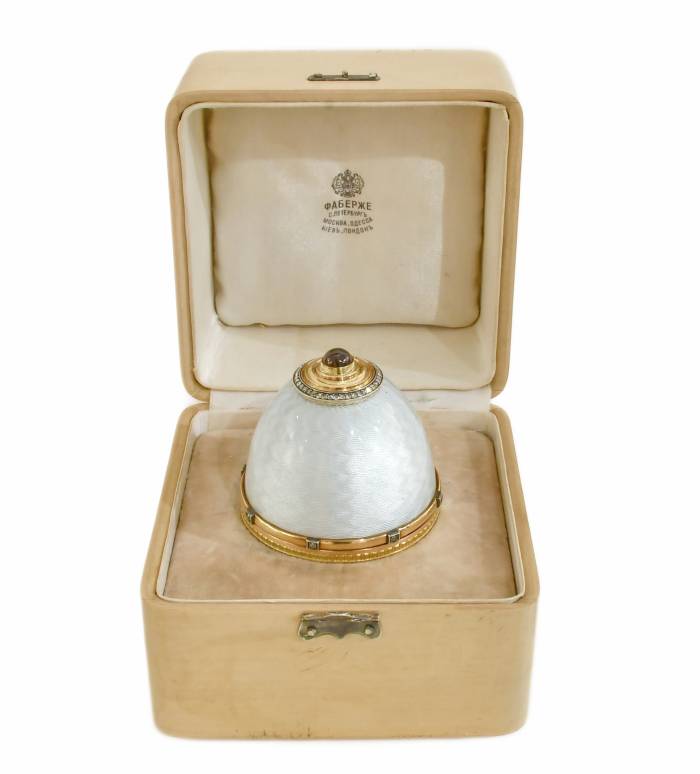
The period between 1903 and 1916 marked the height of the master’s creative activity. Wigström supervised the production of complex jewelled objects including Imperial Easter eggs, presentation boxes, cigarette cases, hardstone miniatures and decorative objects made of semi-precious stones.
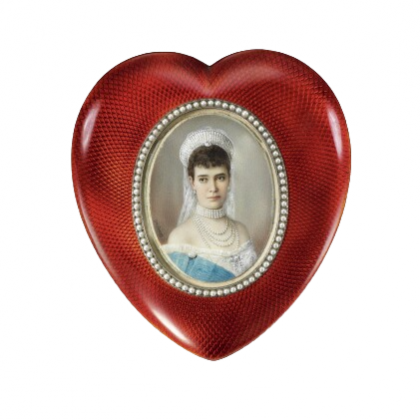
His workshop was distinguished by exceptional precision of execution and a refined sense of historical style. Wigström actively developed the direction of Neoclassicism, drawing inspiration from the aesthetics of the eighteenth century and the decorative language of the Louis XVI period. His works are characterised by symmetrical compositions, garlands, ribbon ornaments, pearl-like borders and delicate guilloché enamels.
STYLE, TECHNIQUE AND DIRECTION
Wigström’s work is associated with the development of the late artistic period of the Fabergé firm. His creations demonstrate harmony of proportions, a refined colour palette of enamels and masterful use of precious and ornamental stones.
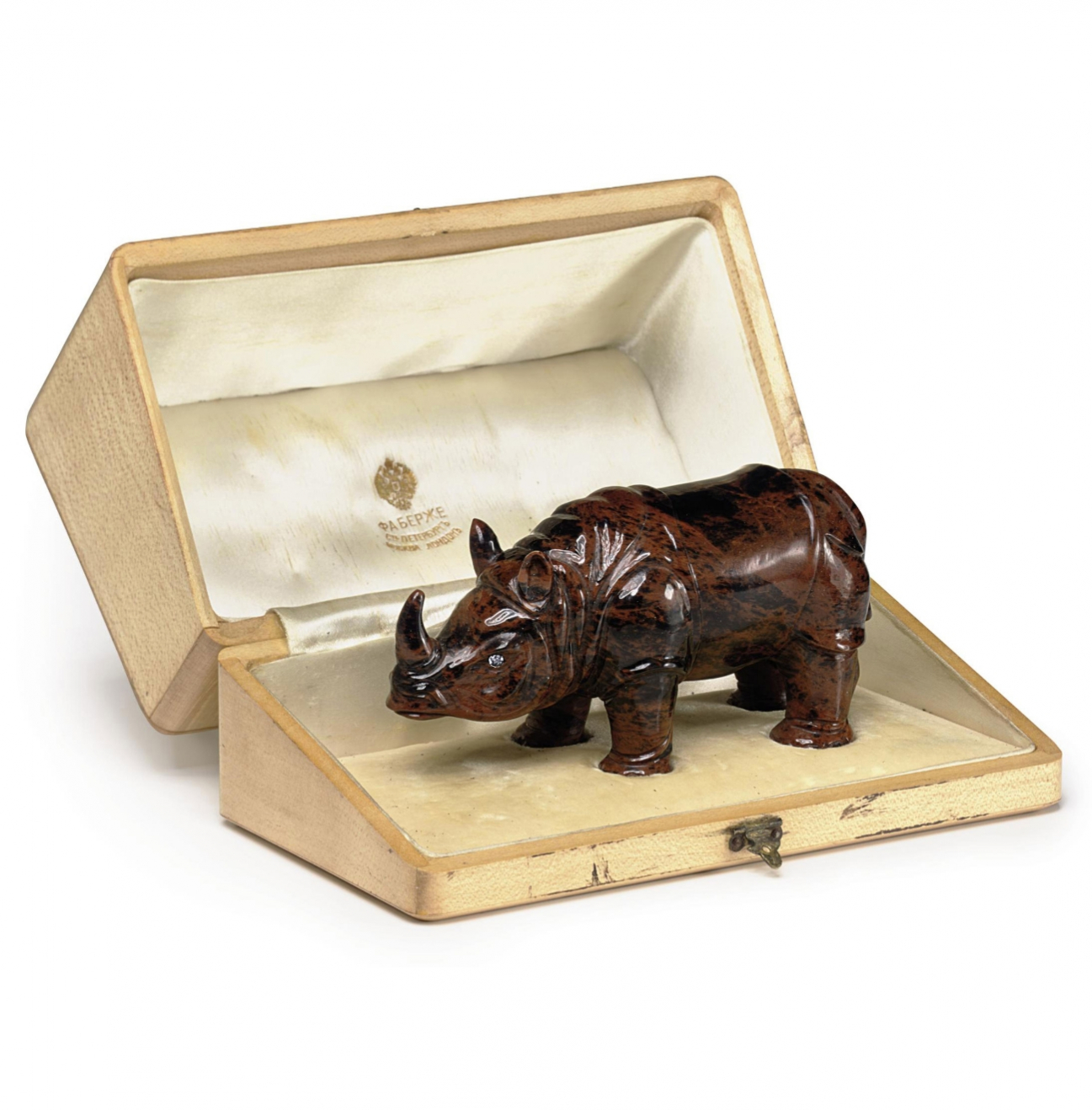
The master frequently employed nephrite, rhodonite, moss agate and other Ural stones combined with gold, platinum and diamonds. Particularly characteristic were guilloché enamels in soft tones - pink, peach and cream.
Wigström also participated in the development of the famous hardstone carving tradition of Fabergé. Miniature sculptures of animals and figures carved from semi-precious stones became one of the distinctive features of the artistic language of the firm.
NOTABLE WORKS
The workshop of Henrik Wigström is associated with the creation of several Imperial Fabergé Easter eggs of the early twentieth century, including:
The Imperial Easter Egg “Alexander Palace” (1908)
The Imperial Easter Egg “Standart Yacht” (1909)
The Imperial Easter Egg “Tercentenary of the Romanov Dynasty” (1913)
In addition to Imperial commissions, the workshop produced numerous gold boxes, cigarette cases, picture frames, hardstone figures and objects made of nephrite, rhodonite and other decorative stones.
MUSEUM COLLECTIONS
Works attributed to Wigström and objects bearing his mark are held in major museum collections including:
The State Hermitage Museum, St Petersburg
The Fabergé Museum, St Petersburg
Victoria and Albert Museum, London
Hillwood Estate Museum, Washington
LEGACY AND COLLECTOR INTEREST
Works by Henrik Wigström represent some of the most significant objects from the late period of the House of Fabergé. Imperial Easter eggs, hardstone miniatures and objects decorated with guilloché enamel are particularly sought after by collectors.
The exceptional artistic quality and the historical connection with Imperial commissions ensure stable demand for his works. At sales of major international auction houses, objects bearing the H.W. mark regularly achieve strong results, confirming their status as museum-level masterpieces of jewellery art.
After the Revolution of 1917 Wigström lived in the vicinity of Petrograd. He died in 1923, leaving an important legacy in the history of jewellery art and in the development of the artistic language of the House of Fabergé.