×
Create account and receive
15% DISCOUNT
your first acquisition
or
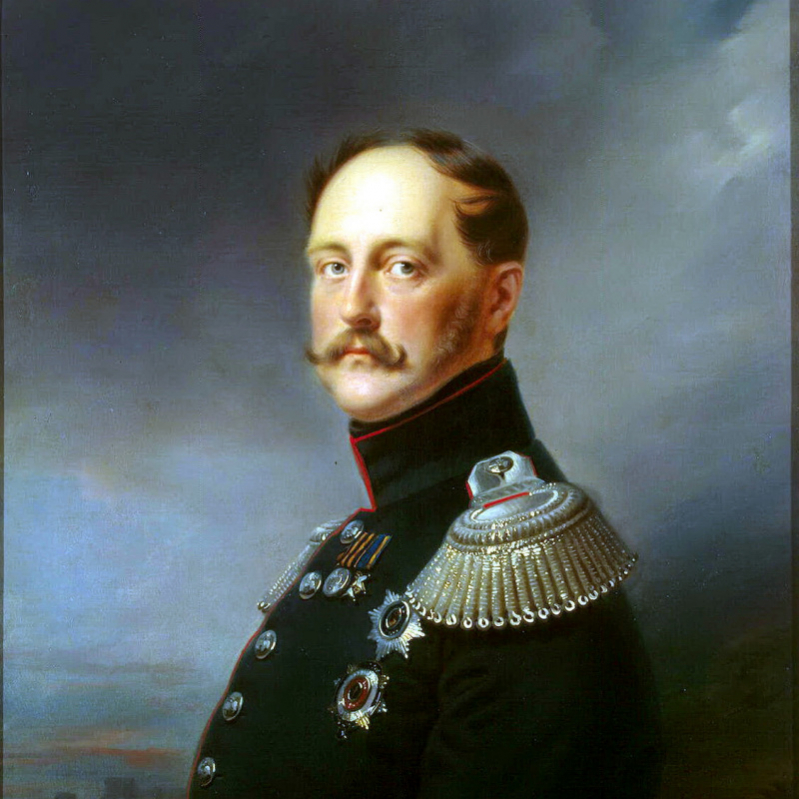
Franz Krüger was a prominent German painter of the first half of the 19th century, active as a portraitist, battle painter and animalier. A professor at the Berlin Academy of Fine Arts and a court portraitist, he worked for the Prussian court and the Russian Imperial court, executing commissions for Emperor Nicholas I. His oeuvre occupies an important place in the history of European court portraiture.
We will only share latest what our month on the FRANZ KRÜGER.
BIOGRAPHY
Franz Krüger was born in 1797 in Grossbadegast, Prussia. From 1812 to 1814 he studied at the drawing school affiliated with the Berlin Academy of Fine Arts, where his artistic formation developed within the academic tradition, combined with an interest in genre and military subjects. In 1825 he was appointed court portraitist and professor at the Berlin Academy of Fine Arts. In 1831 he was elected an honorary free member of the Imperial Academy of Arts in Saint Petersburg. He died in 1857 in Berlin.
CAREER MILESTONES
Krüger’s early period is associated with genre scenes and studies of horses executed from life, which determined his later specialisation as an animal painter. From the mid-1820s he worked extensively as a portraitist of the Prussian aristocracy and officer corps. From the 1830s onward he travelled repeatedly to Russia, in 1832, 1836, 1841, 1844, 1847 and 1850-1851, executing commissions for Emperor Nicholas I and members of the Russian Imperial court. His mature period is marked by the creation of large-scale formal portraits and multi-figure compositions documenting court and military life of the era.
STYLE, TECHNIQUE AND ARTISTIC VISION
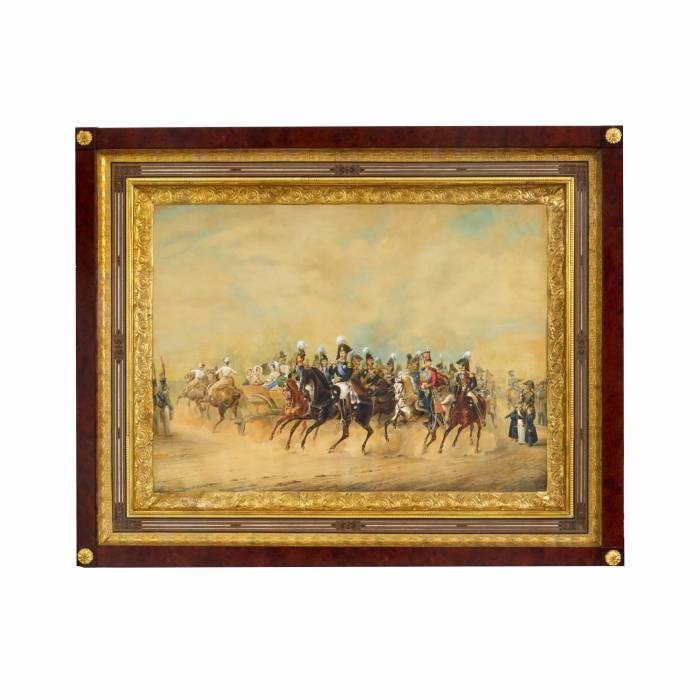
Franz Krüger’s work developed within the framework of Late Classicism with elements of Romanticism. His painting is characterised by precise draughtsmanship, meticulous rendering of costume, arms and military equipment, and particular attention to the depiction of horses as a key compositional and symbolic element. His manner is distinguished by a smooth painted surface, carefully balanced chiaroscuro and a strong commitment to portrait likeness, giving his works the character of visual historical documents.
LEGACY AND MASTERPIECES
Among his most significant works are formal portraits of members of the Prussian and Russian high society of the 1830s-1840s, as well as battle and genre scenes featuring cavalry. His works are preserved in museum collections in Germany and Russia, including state collections in Berlin and Saint Petersburg, and are regarded as important sources for the study of court culture and military life of the 19th century.
MARKET ANALYSIS
Masterpieces: Museum-level formal portraits with confirmed attribution and documented provenance, associated with the Russian Imperial court. Price range €100,000-200,000. Record sale: Portrait of the Tsesarevitch Alexander Nikolaevich, sold for approximately GBP 152,500.
Workshop / Circle: Cabinet portraits and mature works created for court and aristocratic commissions. Price range €50,000-100,000. Record sale: Portrait of Emperor Nicholas I, sold in 2019 for €80,000.
Followers / School: Graphic works and paintings from the circle, focused on genre and equestrian scenes. Price range €10,000-50,000. Record sale: a genre composition with an equestrian motif, sold in 2025 for €38,000.